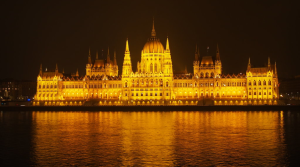
A return to the second half of the 1980s, followed by the further unfolding of personal fortunes and the start of collaboration with József Antall
Transcript:
First, I need to go back a little to the point where I was leaving the army. I mentioned that my father was a professional soldier, and he’s been a professional soldier his whole life basically since he was a young adult. Not necessarily on political grounds, but obviously he was brainwashed in a thorough way during his service.
When I announced to him at home, that I was leaving the military, he first took it very hard, because he thought, as I think many fathers do, mistakenly, his child would fulfill his unrealized dream, and I’ll earn a respectable position, or obtain a rank in the Department of Defense, so something that would be a real stripe on the trousers, let’s say a rank of a general, or the like. That said, a big contributing part of our eventual reconciliation was that back by then, we didn’t live together, my parents divorced, as I mentioned, and our relationship was pretty much kept to a minimum.
I’d be lying if I said it was a real father-son relationship, it was a more superficial, acquaintance-like relationship. I wasn’t particularly concerned with my father’s opinion of my career after that. We didn’t really talk about politics.
So while they were loyal party members, which I can understand today, from a strictly human perspective, and I probably understood it then, because, as I said, they were able to rise out of their family background, coming from poor families, they were able to learn, to achieve. My father, for example, became a colonel in the army, and as I said, he was also chief of logistics in Ercsi, so he achieved certain important positions in the army, and my mother worked at a middle management level at Post Office 62. So they attributed all this to the system that their lives could develop in this way.
Or if you think about it, how did a price increase happen back then, for example? This will have significance in relation to the taxi blockade. The decision on the price increase was made in the Central Committee. Then they leaked it consciously to the party members.
The party members obviously told their families, their environment, and by the time the price increase took place, and usually not all at once, it was a gradual increase most of the time, and people already accepted it, they swallowed it without any problem, and there was no social outcry. So they (my parents), as party members, could feel a little bit like insiders, in that they could get access to certain information sooner than others, at party meetings. Still, they were not in a privileged position, but again, the way their lives were going, at least for the better, they attributed it to that, and that’s why they believed in this system.
The real, definitive break with the party, which I have mentioned already, occurred when the new government was formed, later I took office as well, and they gained access to new information, in part through public service media, and newspapers, so information wasn’t so tightly controlled anymore, and through me, they accessed information that really opened their eyes, and they realized how many times they’ve been lied to, how many times they’ve been duped, and how the system was being upheld by what was essentially conscious, constant brainwashing. So clearly, the real big push for them came as a result of the subsequent development of my fate. I also mentioned that, when I got to the Justice Department, that was a certain grace period.
I think it’s due to the previous generation retiring from the Justice Department, and the hiring of nearly twenty young people almost my age, from the end of ’85 to the beginning of ’87. So we have very young, fresh law graduates coming to the Ministry of Justice, and we have this deputy minister, who, although he’s been there for a long time, – perhaps its due to this Markója whose influence on the ministry was gradually shrinking -, He started living an independent life professionally, and I say, under his authority began a professional preparatory work, which was then later on finished by Kulcsár and others, concerning the regulation of freedoms and other issues, but I emphasize, it’s all thanks to Ferenc Petrik.
And as you can see, young, fresh lawyers were given an unorthodox kind of task in terms of codification, and it was surprising that in a one-party system, even if it was softening, but still, a dictatorship, the rights of freedom could be regulated, like the right of assembly, even with events happening, like the one at March 15th 1986, the police dispersed a crowd of 15,000 demonstrators by force, during the famed Battle of The Chain Bridge, and yet we could regulate how the right to demonstrate and the right of assembly could be exercised legally. So these meant a lot to us both from a moral and a professional perspective. And I would be lying if I said that we drafted the Law on Associations in order to give the opportunity to form alternative opposition organizations, but in the meantime it turned out that we accidentally managed to open a legal loophole, and we were very proud of this, but I would like to emphasize that at least at that time it was not a conscious professional attitude or activity on our part.
The interesting thing is that I think that by ’88, serious lines of divide were developing within the MSZMP. On one side were the reform communists under the leadership of Pozsgay, Miklós Németh, and then there’s also the hard-liners, the Károly Grósz, Fejti team, who didn’t really want to agree to the idea of introducing a multi-party system here, or even a relaxation of party control in the country. They didn’t really want to take any notice of the Gorbachev-Bush agreement, while, once again, they were officially informed that the Soviet Union will not intervene in the internal affairs of any country, if it comes to that.
On the other hand, Soviet troops are still stationed in Hungary, as a threat. I myself felt the easing of the system, or at least the inner rivalry within the party, in that, as I said, after each day of round table discussions, Fejti’s personal secretary had to report back. And each time he came back saying, “Well, kids, I’ve been seriously scolded.”
And then sometime after half time, since the negotiating series started on June 16th, if I remember correctly, and ended on September 18th ’89, so sometime during half time Imre Pozsgay, who was the head of the MSZMP negotiating delegation at a high level, went on leave. For two or three weeks. And György Fejti took over in his place, the political leadership of the whole round table, at least of our negotiating delegation, temporarily.
However, one more thing I should say is that when the negotiations started, before the very first substantive negotiation, the members of the negotiating delegation representing the MSZMP were summoned to the party center, this is now the House of Representatives, and we had a briefing. Imre Pozsgay stressed here, in a presentation of I don’t know how many minutes, that there has to be a presidential institution of the republic, and the rest doesn’t matter. So the most important result must be that there should be a presidential institution of the republic.
We understood that this clearly translates into the fact that he wants to be President of the Republic, which later turns out to be his main ambition indeed. All the while, Kilényi said that the most important thing is to have a constitutional court, so clearly he wanted to be a constitutional judge. György Fejti also made a speech, and he said we can’t give into anything, we can’t make any concessions at all.
So everything must remain as it is.
The sole legitimacy of the one-party system is inscribed in the text of the constitution, and that’s what must remain, so we can’t give in on anything. That’s how the negotiations started, and as I said, I was not a party member, and József Antall basically gave me moral acquittal at the very first hearing.
I and the others, on the basis of our professional conscience, did not follow the instructions of Fejti, that we should not give in to anything, instead, we envisioned an optimal text for the constitution, and we tried to move towards that during the negotiations. So as I said, Pozsgay went on leave, and we were summoned again, as before the series of negotiations, where we were scolded by Fejti in an unqualifiable tone and style for about half an hour, that we, the 1/1 Subcommittee of the MSZMP negotiating delegation, were sliding on our bellies to give into the opposition, and so on. And I’ll tell you frankly that I was born under the sign of Taurus, and my family and acquaintances say that I’m a very calm person, but there’s a limit to when I lose my temper, and then, it’s better if no one stands in front of me.
Well, that moment came right then and when he asked if anyone had any questions, I was the one to come forward first, and I stood up and said on behalf of myself and the whole team, that one, we were briefed by multiple people with conflicting interests, that obviously could not all be followed because we either have a president of the republic only, and nothing else, or only constitutional court and nothing else, etc. And so I said that there is no belly sliding and dishonor on our part, we negotiate on the basis of our professional and human conscience, and we will continue to negotiate this way in the future, if he doesn’t like it, then he should replace us and fire us.
After that, during the break, several people came up to me and said that no one has ever spoken to the Central Committee Secretary like that at the party headquarters. Well, I never set foot in the party HQ before, I wasn’t a party member, so it was easy for me. I would like to say that even then it was not such a conscious political statement on my part, I was simply outraged by his style and everything that was said against us, and I felt that we, who really did negotiate day and night, probably deserved something more, and not such a vulgar and unqualified scolding. Then Pozsgay came back, yes, and thanks to Fejti taking the lead, it almost looked as if the negotiations would break down and the National Round Table negotiations would not come to any conclusion, but thank God, Imre Pozsgay came back, and then the situation was normalized again, with great difficulty, and finally, as I said, we got to the point where the agreement was reached on 18 September.
By then…
(One of the interviewers): Were people aware, were you aware of the conflict between Fejti and Pozsgay?
(Kajdi): It was more like, shall we say, street news, because then, if you think about it, in early 1989, exploiting the fact that Grósz was abroad, Pozsgay announced on the radio, that 1956 was not a counter-revolution, but a popular uprising. A scientific academic committee reached this conclusion, and he announced it officially. I know this resulted in a huge scandal within the party. By the way, returning to my family, it was interesting that this also shocked my father as well.
He was also outraged, that “How come it wasn’t a counter-revolution?” He was a soldier in ’56, and their uniforms looked very similar to the uniforms of the ÁVH’s (secret police 1948-1956) personnel. And they were delivering bread to I don’t know where, revolutionaries stopped their truck, captured them, put them up against the wall, and were about to execute them for being secret police agents.
Then, a revolutionary came along, a mid-level leader of sorts, and said: „You idiots, don’t you realize that these are soldiers, not ÁVH agents?” And that saved his life. But this memory was so ingrained in him that for him it was also a counter-revolution, and when Pozsgay said that it was a popular uprising, he took it as treason. Back then, having read the Beszélő, obviously, I did not treat it as treason, and didn’t take the news like my father did.
But it was never a family discussion. We rigidly avoided politics. By the way, I think the party was in a state of disintegration at the time.
This was the reason why in October ’89, the MSZMP, as the state party, split up and the MSZP was formed as its legal successor, the Hungarian Socialist Party. In all respects, it inherited its assets, which later gave rise to serious disputes and parleys in the subsequent government period. But it is clear that the 850,000 party members have suddenly been reduced to 30,000, according to my memory.
So the MSZP’s founding party membership was 30,000. Suddenly 820,000 party members disappeared from the membership register, which revealed that many of them were not party members by heart, in my opinion, many of them were only party members because of their careers, as I mentioned to you, the possibility of a career in the administration, and for that you had to go to the party headquarters, and obviously you couldn’t be a party member outside the party. And also, a lot of people joined up because of the idea that I mentioned, when I was in college, that you have to “reform from within”, and that you were supposed to join the MSZMP in order to change the system from within the party.
So that’s how a lot of people became party members. I honestly don’t want to judge anybody. I stayed away from that because of my laziness, my neutrality and I don’t know what, and I was never a party member until I was 55, so that’s how I did it.
I’ve spent a significant part of my adult life as a non-party member, but I don’t want to bang my chest, because I have no basis or right to do so, it wasn’t a conscious oppositional attitude or behavior that led me to do it. So that’s all I can say about the MSZMP. Once again, all credit to the old, socialist parliament, which was obviously under pressure from the party center, that the drafts that were proposed at the National Round Table were eventually passed as bills, and a good part of the regime changing took place between then and the free elections that were held.
I mentioned the Pact, which is a nasty word, by the way. The Pact has a bit of a negative connotation, which, if you think about it, was a very positive development in the recent history of Hungary, because it allowed the Antall government that was formed later, to govern at all, and the executive to function. But coming back to my personal fate, I mentioned that on 8 April, of course, along with the majority of the country’s population – I reckon -, I was sitting in front of the TV, waiting for the results, shocked to see that, – I was not shocked by the results -, but if you remember, György Balló was broadcasting from the Election Center, so in every party headquarters there was a prominent reporter of Hungarian Television, and when the final result was announced, György Balló was basically crying in despair, that it was not the SZDSZ that won the election, but the Hungarian Democratic Forum, and for example, the victory speech of József Antall, as leader of the winning party, was not broadcast in full by the Hungarian Television, but was cut short and taken off the air half-way through instead, so I must say that this was an interesting moment demonstrating the media situation of the time.
But I was very happy, I knew that József Antall would be the prime minister, but I would obviously stay in the Ministry of Justice, and I would do my job as deputy head of department. So the 8th was a Sunday, so this story took place the following Friday. When I left the Ministry on the following Friday, late in the afternoon, my then Chief of Staff, Edit Papácsy, usually had me stay late every Friday afternoon, when my colleagues were discharged and could go home, and we would smoke cigarettes, eat a sandwich, with a little cognac and so on, we discussed what work had been done, what tasks had been done this week, what tasks would be done next week, so we planned essentially the work programme for the following week, and that’s why I usually didn’t leave on Friday at normal working hours, but a few hours later. I don’t think there was anybody else in the ministry at that time, and the way you could call in at that time was that all the phones in the ministry were switched off, and if somebody phoned in the ministry, it would ring at the reception.
And I was just leaving the ministry when I heard the telephone ringing at the receptionist’s, and the receptionist answered it and said to me, “Comrade Kajdi, (we still called each other „comrade” back then), you have a call.” Well, my surprise was twofold, one was, how did the receptionist know me by name, I’m a deputy head of a small department in this ministry, there are a lot of those besides me, but okay, so he knows me. My second shock was when I put my ear to the phone, and said hello, the familiar voice of József Antall was talking to me on the other side, saying “Hello there, Jóska”, and he asked me to come in on Tuesday.
Then he said „Goodbye, have a nice weekend”, and dropped the call. Well, needless to say, I was wondering all weekend, why I had to go to see József Antal, the future prime minister, and what he wanted from me. My other question was, where did I have to go exactly? And that’s why on Monday morning when I went to the ministry, I asked a colleague who was a university classmate of Antall’s eldest son, and I knew that he sometimes came to Antall’s family for Sunday lunch, a country boy, so I said to him: „Sorry to bother you, but Antall told me to drop by, what did he mean by that exactly?” He said, „You must go to the headquarters”, „But” I said, „Where is it?” So that’s about how informed I was about the political situation at the time, and he said „You idiot, as soon as you turn around the corner of Bem Square, you’ll see a big MDF flag above a building, go and head inside.”
So I did as he said, I went in, I said I was looking for the party chairman, I went up to the first floor, where I was greeted by József Antall, he was very kind, he asked me how I was doing, how the children were, I had two small children, and after a few kind, polite sentences, he said, „I would like to ask you to be the head of the government office.” Well, I’ll be honest, I’m 31 years old at the time, I’ve been working in the administration since ’86, I’m a deputy head of department, the second man in a small little department, and I get this invitation, I couldn’t believe it, and all I could say was, „I’m sorry, I have to discuss this with the family,” because I knew that much, – partly because of how we had been discussing things at the round table negotiations, and partly as I also thought about it afterwards – that we were now entering a period in the life of the government, where a job like that would require not one man, but three, especially in a position like this, and I knew that there would be a continuously functioning Parliament, a continuously functioning government. Until then the government met every two weeks, and, as I said, first of all, the material went to the KB (MSZMP Central Committee), if it was approved by the KB, then the government did not change it at all, so the government meetings were completely ceremonial, but it was clear that from that moment on the party center ceased to exist, it was integrated into the government, so basically the political and the executive decision-making body would be one and the same, with continuous government meetings, the administration, the ministries would have to be reorganized, so it was a very serious task, as I’d like to emphasize. I was aware that, as a relatively young married couple with two small children, it’s no small thing to start something like that, and so I told the news at home, and a family meeting was held, with my mother, my wife’s grandmother, my father-in-law and my wife and I, and I asked them whether I could do it or not. My father-in-law, who had worked in the administration before, and later became the dean of the Győr law faculty, he was a lawyer and knew what administration was all about.
He said, “Son, you have to take this on, it’s a historical moment, even if you’re just a little part of it, nobody can take that away, and yes, it’s a historical task that you have to accept.” The two grandmothers said that they will help in everything, and that yes, it has to be done. My wife also said that she knows that as hard as it will be, she knows that I am not going to be a husband or a father for four years, but still, she is doing this.
So when I went back to see József Antall a week later, he didn’t ask me any questions, but we sat down straight away, and we started to work, which meant that he immediately gave me various tasks. He first explained to me that he wanted to separate the political sphere from the professional sphere, and that is why within the government, the ministers and the political state secretaries are politicians, while the position of the administrative state secretary is a professional position, and his professional deputies are the deputy state secretaries.
If there is a change of government, the professional people are stable, and they stay, this provides continuity for the executive power, at least from a professional point of view, and the politicians obviously leave, because they only take the political course for the mandate that is given to them as a result of the election. That’s why there were bills drafted right away, including what ministries he wanted to set up, creating a new ministry, the Ministry of Labor, strengthening the Ministry of the Environment, and giving back old names for some ministries, to better emphasize their intended role, for example: the Ministry of Health and Social Welfare became the Ministry of Public Welfare, but of course he kept the classic ministries, like the Ministry of Defense, the Ministry of the Interior, or even the Ministry of Finance. And he also said that he wanted to transform the office of the Presidium, which existed up to that point, which was thus transformed into the Prime Minister’s Office, which reflected much better on the constitutional situation, which essentially elevates the Prime Minister from the government, which is due to the constitutional amendments, resulting from the round table negotiations, and the pact (MDF-SZDSZ pact), which basically makes the government dependent on the Prime Minister.
As long as there is a prime minister, there is a government, the prime minister is elected by parliament, along with his programme, but the choices of ministers are not subject to the decision of anyone but the prime minister. He proposes the ministers, who are appointed by the President of the Republic, and it is up to him to decide who will be promoted and who will leave his government. So clearly the Prime Minister has a very strong constitutional position.
I have to say that we started to move a little bit towards the chancellery model with this government structure, which later on also meant the creation of the referatorship system within the Prime Minister’s office.